Showing posts with label Haiti. Show all posts

November 15, 2010

Cholera


Now that the hurricane is past and the rains have stopped we are watching the cholera situation. The official count now lists the number of deaths from cholera nearing 1,000, with another 12,000 being treated. Because of the poor hygiene conditions in Haiti, the bacteria is spreading at an accelerated rate. The poor living conditions and lack of clean water aid the spread of the bacteria.

With the death rate exceeding 100 per day, there is a problem of what to do with all the deceased. There is a shortage of coffins and also unavailable space to bury the people. More and more cases are appearing in Port au Prince where the situation is especially precarious since the city is still full of rubble from the January earthquake and since so many are still living in tents.

People on the Dominican side of the border are watching the situation in Haiti and hoping the cholera will not spread to this side of the island. There have not been any "official" cases of cholera in the DR yet, although there have been several reported cases. For the past two weeks the border has been closed and the authorities are keeping a tight watch on anyone coming over the border, most Haitians are not allowed to cross into the DR. The border was opened for a short time this past Friday, and three women were trampled in the stampede of people that tried to cross into the DR. This is causing increasing tension between the two countries. The governments of the two countries are trying to come to an agreement of an orderly passage of people over the border, but until they formulate a plan, everyone is watching and waiting.

August 12, 2010

Haiti. Seven Months

Haiti Prepares for Upcoming Elections

The National Office for ID's has been flooded with people requesting an ID card to be able to vote in the upcoming elections. Every day more than 1,000 people stand in line requesting this identification paper. Unfortunately, there are only 3 offices where citizens can apply. (Alter Presse)


Seven months after the quake, people from the tent cities staged a sit-down in front of the National Palace. They are demanding that the government of President Preval grant them access to decent living quarters. The homeless are fearful of forceful expulsions from the tent cities. Everyone knows that seven months later, the conditions are horrible, a situation of prevailing misery without any respect for the principles and guidance of the UN for the internally displaced. To date, only 3% of the refugees have been relocated. (Alter Presse)


Thirty-four candidates have submitted their names for the upcoming elections. The electoral council has 10 days to approve the validity of the candidates (Aug. 17). The election of Nov. 28 will choose not only a new president but also 10 senators and 89 members of the parliament's lower house.

Haiti's next president will face an enormous task of rebuilding a country devastated by the Jan. 12 earthquake. The office is never an easy job. Presidents have only rarely completed a constitutional five year term. Most in history have been overthrown, assassinated, declared themselves "president for life", or some combination of the three. (Evens Sanon, Haiti Star)

July 20, 2010

Haiti, Six Months Later

"We've been forgotten", "We don't know where the international aid is that everyone talks about", "People are suffering, baking in their frayed tents", "Where is the reconstruction?" "Haitians complain of little or no food, a lack of local government leadership and no escape from the tent cities".


These are just a few of the comments occurring more and more frequently in the Haitian news. People are becoming desperate as their situation fails to improve. Following are a few excerpts from local newspapers describing the current situation six months after the tragedy.

President Preval announces Nov. 28 as voting day to choose new president. But organizing elections will not be an easy task. The electoral councils headquarters were destroyed and records lost in the quake. Millions of voters were either killed, made homeless or displaced.

Haiti's constitution does not permit Preval to run again. Haitians propose
Aristide as a possible candidate for upcoming elections. (Haiti News)

Hospital Closing
In the days after the Jan. 12 earthquake, doctors flocked to Haiti to volunteer in the country's private premier hospital. Six months later, the hospital is closed. Not accustomed to providing free care and missing deadlines for getting international aid, the hospital shut down in April.

Promises of support from military organizations and more importantly, money, never materialized. Money promised by charities never came through. The hospital's administrators, in an oversight, were late meeting deadlines for other forms of assistance.

The hospital had to close when its owners could no longer afford the 400 gallons of diesel needed every day to fuel generators or for the salaries for the staff of 170 caregivers who kept working despite damage to their own homes. (Haiti Net)

There are warehouses filled with food, goods and medical supplies already in Haiti. A lot of it arrived in Jan. right after the earthquake, but because of the lack of coordination between the relief organizations and the government, it is just sitting there. That blunder is costing lives. (Haiti Star)

Reconstruction
In the immediate aftermath of the quake, 1,340 tented villages and squalid camps sprung up, and are acquiring an ominous air of permanence. The inhabitants stay because their homes no longer exist or because their landlords have used the housing shortage to drive up rents.

Why isn't rebuilding taking place? Lack of money, incompetent governance and the sheer quantity of the rubble are all factors. About 60% of the emergency relief that was promised was delivered. But only a small fraction of the $5.3 billion that was pledged for reconstruction has materialized and much is in the form of forgiven debts - not cash. Some workers say the biggest barrier to reconstruction is government ineptitude and bureaucracy. It takes months for an aid organization to register with the state. Until then, they must pay a 30% tax on goods brought into the country.

What about the rubble? Only 5% has been removed since Jan. If trucks worked at it every day, it would take 3 yrs. to remove it all. Al the current rate, it will take an estimated 20 yrs. or more.

Land tenure causes further complications, it's hard to know who owns what. Many of those living in tents did not own their homes - they were renting. But even those who did own property are unlikely to have proof. Only 5% of Haiti's land is accounted for in public records - and the building that housed title deeds was flattened in the earthquake. There is no proper land-registry system. Land titles pass informally from one generation to the next, largely because titling costs several thousand dollars and public officials are generally held to be corrupt. (Money Week)

Preval announced that the six month emergency phase has ended and reconstruction has begun. The distinction was not lost on some Haitians.

The most visible early emergency programs such as massive food distributions have stopped. Tarp and tent building are growing instead of shrinking - 665,700 plastic tarps and 97,000 tents were handed out, but most are now falling apart. The number of people in relief camps has nearly doubled to 1.6 million.

When building materials finally get through customs, there is nowhere to put them. Fights over land rights, customs delays and slow coordination between aid groups and government have hampered nearly everything.

Donors have met 10% of a promised $5.3b promised for reconstruction - separate from the humanitarian aid, mostly by forgiving debts, not providing cash. (Taipei Times)

June 9, 2010

Tattered Tents


How long would you live in a tent? It has been five months since the earthquake and the majority of the victims are still living in tents. But tents are not designed for long-term living. After months of the hot sun beating down on them, now heavy rains and high winds are deteriorating the tents.


The population is becoming restless. This past week shots were fired toward the house where President Preval has been living since the tragedy.


And while the people are trying to keep dry from the rains and hope to dry out their soggy mattress before the next rain comes, the leaders of the international community met at the Moon Palace tourist center, a five-star resort in Punta Cana, DR to decide how to help Haiti.

(Photo from El Caribe newspaper)

May 28, 2010

Haiti Herald, May 28, 2010

Registering the Population
The OAS has begun developing a civil registry in Haiti that includes minors and children. The most basic elements of social and economic planning and development require a clear accounting of the population and their location. This process was started five years ago and more than 4 million adults had been registred when the earthquake hit on Jan 12. Efforts have been renewed since Jan. and some 1,500 children and their parents or guardians have been registered so far. (Caribbean News)

Relocating the Homeless
President Preval underscored the relocation of the homeless as a priority before the beginning of the hurricane season. But he has not found the magical formula to carry it out.

Relocating the homeless has become worrisome for the Haitian government and the international organizations intervening the the post-disaster activities. Many strategies have been studied, but none so far offers the desired effects.

People are being allowed back into their homes once they have been inspected. Some 40% of the homes in Port au Prince are still habitable. Some people who could be back in their homes refuse to return prefering to live in the camps where they can take advantage of receiving water, food and sanitary facilities.


7,000 homeless were forcefully removed from the soccer stadium. Another 245,000 are in danger of flooding during the rainy season. Seven tent sights have been declared high risk areas. Government officials make regular visits to these areas urging the people to consider moving. President Preval says that housing is his first priority. "Relocating 1.3 million people who sleep on the streets will take time and will be costly. We have started with those who faced the greatest danger. The reconstruction is going to take a long time". (Le Matin)

(The following is an article that explains a little about how the political system works in Haiti. It is a bit lengthy but I found it to be very instructive about insights into how the country is functioning).

Haiti and its flawed electoral process!
By Jean H Charles

The Haitian Constitution stipulates that regular presidential elections shall take place every five years on the last Sunday of November, with a presidential inauguration to take place on the following February 7, to correspond ab eternum to the day the Haitian people delivered themselves from the Duvalier dictatorial regime.

The earthquake of January 12, 2010, has destroyed the capital city of Port au Prince as well as surrounding cities of Jacmel, Leogane, Petit Goave and Grand Goave, with more than 1.7 million people sleeping under a tent, sometimes in the rain amidst squalor and the mud. Vital records have been destroyed, the dead have been cremated without proper state sponsored identification and the Preval government has exhibited a culture of deception, corruption, and perversion of the electoral process. It is a perfect storm to create a disaster in lives lost in the next few months. It is also the perfect tool for maintaining the status quo through a flawed electoral process. Yet the international community, through the voice of the OAS Assistant Secretary General Albert Ramdin, the United Nations representative Edmond Mulet, the CARICOM delegate PJ Patterson, is pushing full speed ahead for a flawed election to take place under the baton of Rene Preval, a master mind of cunning, double talk, and plain disregard for the plight of the majority of the Haitian people.

May 18 commemorates the weaving of the flag made with the blue and red piece of cloth from which the white piece symbolizing colonial France has been extirpated. On this very day of celebration, the people of Haiti are demonstrating en masse, on the street demanding the forced departure of the Preval government so they can go on with their lives, and ensure a fairly clean election. Will Preval and the international community, through misguided policy, succeed in maintaining a status quo that will lead to disaster in the coming months of the hurricane season with millions of people at risk? Or will the Haitian people succeed in forging a new order of business in running the Republic of Haiti?


Haiti has been sinking deeper into bigger risk in food security, diminution of human life protection and severe environmental degradation. The international community has responded with unusual humanity and compassion to the earthquake-stricken Haiti with ten billion dollars, the corrupt regime and the partisans of the status quo will easily sink $100 billion with no apparent result for the Haitian people. They have discovered a brand new concept: disaster profiteering.

Not one of the 565 rural hamlets of Haiti has received any funding for infrastructure and institution building. Seven million Haitian people out of the 9 million population live in extreme misery, neglect and ostracism from their own government.

May 15, 2010

Haiti Herald, May 15, 2010

Manifestations Demand the Resignation of Preval
Protesters are demanding that President Preval resign. His term was due to end in Feb. but presidential elections may not be held until Nov. because the earthquake destroyed voting records and polling places.

The entire lower house and one-third of the senate are no longer sitting because the earthquake prevented Feb. legislative elections from taking place. Effectively, the parliament is ceasing to exist as a governing body. This concentrates power in the hands of the President and the international commission that has been set up.

The commission, co-chaired by former President Clinton is to oversee the $9.9 billion US for foreign reconstruction, money pledged at a March conference, a sum 40% larger than Haiti's entire gross domestic product.

Many protesters say that Preval has sold the country to foreign powers, while the commission violates Haiti's sovereignty. (Haiti Globe)


Four months after the quake, and people are still living in tents. "We've heard that foreigners have given lots of aid money. But we are still living the same way as before, and we're still dying the same way," said Davery Nulmeus. Haiti's needs are still enormous, but more than 100 days after the quake, the plan for dealing with them is unclear. (Haiti Press)

Reconstruction Blackout (Haiti En Marche)

The earthquake killed 300.000 people and destroyed 500,000 homes. With international aid, the government is taking inventory of the losses. Some buildings are a total loss, others need to be demolished. Some can be repaired but need to be reinforced to prevent hurricane damage or further damage from more earthquakes.

But while we wait, those who are in charge have been totally vague. No one seems to know what to do.

No one knows what Port au Prince will look like in 6 months, one year or ten years - or even if the capital is condemned to remain in its present state. At this stage, nothing seems impossible. In any case, the Reconstruction that everyone else is talking about seems to be a foreign word for the administration.

The people await their words of wisdom. Everyone realizes they need to be understanding of the difficulty of the situation, even those who have the means to begin reconstruction. But the officials continue in their silence.

Even if they don't know the agenda for the future projects, they at least have some idea of what is being planned. They would do well to inform the population - if only to be able to inform them that they will not continue living in this situation indefinitely, to give them some spark of hope that there will be some kind of order in this monstrous cacophony that reigns now in the capital.

Who knows what the capital could look like after this huge earthquake that affected each and every one of its inhabitants? This is the subject of conversations in all of Haiti. Rumors are flying. But the people involved are the last ones to know.

The people are forced to get their information from foreigners. The people being affected are the last to know. That is the rule in Haiti.

So everyone tries to keep on hoping. Do the people who actually live here have a voice in the plans? A city should be built for its inhabitants and not just for the pleasure of building.

We need to reawaken the spirit of being a good neighbor, not just trying to protect our own territory. The people dream about a change.

We hear people say all the time: "If I rebuild, and the the State decides to put a community center next to my house - behold the chaos".

With regard to the Reconstruction, it seems that everyone's mouth has been sewn shut.

Until now the population has remained calm. But if the hurricane season causes another catastrophe, the absence of information will leave the people only one choice, as a popular refrain says: Each one for themselves and all for God.

And that will be the end of everyone's dreams.
(This article taken from Haiti En Marche, May 12, 2010)

April 24, 2010

Tents


Another common theme among the Haiti pictures are the tents. At first glance, many of the pictures seem similar and you may think you are seeing the same thing. Rona explained that after the earthquake all the parks in the city were taken over by survivors. What you are really seeing are different tent cities in different parks around the city.


People prefer these park areas since they usually offer a bit of shade from the hot sun.


This is one park that was closed off to keep people out. City officials hope to preserve the park.


This is the "family" tent. Rona's family sleeps in this tent at night since they are afraid to go back into their house until it has been inspected.

April 23, 2010

Lines in Haiti

Rona shared some of his photos from his various trips into Haiti. Here a few that give an idea of what people's daily lives are like since the earthquake.


This is the food line. To receive food, you must first stand in line to receive a coupon. Once you have the coupon you are eligible for a food ration. The system for receiving the food is not very organized. There is only ONE line, no matter how many people are in that line. (Rona said it could be up to 2,000 people in line). Everyone must wait in the hot sun until it is their turn. This can mean ALL day until your turn comes.


There are also lines for water. This water is for cleaning and washing, but not for drinking.


Stand in line to receive medical care. There are clinic tents set up in different parts of the city. Some were placed under trees and have shade. Those that don't have any shade turn into saunas when the sun beats down.


Work line. Some international organizations offer to pay $5 a day to workers who are willing to help clear rubble. Workers are also allowed to scavenge for materials that they could use for the reconstruction of their own houses.

April 15, 2010

Haiti - Three Months Later

Reconstruction - Are We All Speaking The Same Language? (from Haiti En Marche)

President Rene Preval gave a press conference in NY. Questions from the national press and international press are not the same. Foreigners are focused on preparing the refugees for the oncoming hurricane season. The President can answer easily enough that the government will appropriate lands outside the capital to relocate thousands now living in tents. But, what about the rebuilding and helping the people not receiving food, medicine and tents? In regard to the rebuilding of the capital, the government has not made any statement.

What do we mean by reconstruction - really? Who gets what? Can we rebuild all the houses in Port-au-Prince that were destroyed by the earthquake? What are the conditions for rebuilding? Who funds it?

When we start talking about rebuilding we need to get the banks open and operating. The banks need to give out credit, but how can the banks recover their own losses when their buildings were not insured? What about private homes? There is no precise answer.

While the US press talks of a Reconstruction Commission overseen by former president Clinton and Haitian Prime Minister Jean Max Bellerive, President Preval says these plans are all very premature. The only thing we know for sure is that the World Bank will handle the reconstruction funds.

* * * * * * *
What is really happening in Haiti? Rona Abraham came back from Cap Haitian this past week. He had spent two weeks in the neighboring country doing evangelism work and visiting his family. He showed us a receipt for medications (see photo) for his cousin who had been hurt in the earthquake. When he went to the pharmacy to get the medicines - he had to pay for medicines that had been donated for earthquake victims! You can see the stamp on the left side of the receipt PAYE (paid). When they questioned the workers as to why they were charging for these medicines, they just shrugged their shoulders. He says that food and tents that have been donated for victims are also being sold.

* * * * * * * *
The first group of victims was to move to the new government camps on April 15.

Aided by the UN and the US Army, Camp Corail should be ready to receive 8,000 people. The camp is 20 km (45 min) north of Port au Prince. People are hesitant to move to the new camp, only a few showers and latrines have been installed, about 20 large white tents, the school is still under construction, camp management is just getting underway. The move is planned to begin on Sunday. Everyone who stays in the new camp will receive $50 - after staying for two weeks.
(Haiti En Marche)

April 8, 2010

Haiti Herald, March 8, 2010

Restoring agriculture is seen as crucial to help Haiti feed itself and to provide jobs. The Haitian government estimates that it needs $1 billion over the next decade to revive the agricultural sector. - Brazilian scientists are developing 50 acres to plant corn, rice and beans. - The UN Food and Agricultural Organization has started a cash-for-work program to help farmers replace 20-30,000 wheelbarrows, shovels and other equipment that were lost in the earthquake. (Haiti Globe)

School will officially open on April 5. The Ministry of Education encourages all schools that are able to re-initiate classes. New school calendars and programs will be distributed by the government to help teachers get back on track. (Haiti Press)

Now that the government has officially set a date for reopening schools they face a new dilemma - what to do with the refugees living on the school grounds? Will they force refugees to leave school premises? Where will they go? The new camps are not ready. Refugees refuse to abandon the schools - the only safe place they have to live. "If necessary we will defend ourselves. We are ready to burn tires if they come in". The refugees are already organized in the camps where they are living. Many receive weekly humanitarian aid that they would lose access to if they moved to a different area of the city. Medical services are also readily available where they now live. (Haiti Press)

Rubble from the quake will be used to rebuild the capital. Officials plans to reuse much of the debris being cleared away from collapsed buildings. About 90% of the construction debris can be recycled. The debris from the Jan. 12 quake is enough to fill the LA Superdome - 5 times. (Haiti Star)

According to it's own estimates, the government of Haiti pegged funds needed to rebuild the nation at $4 billion. Donor nations have already committed more than $5.3 billion over the next two years. The international monies will be used to build hospitals, schools and government buildings.

Update: Schools did not reopen on April 5 as planned. Most schools are still rebuilding. The majority of the larger schools were severely damaged. Of those that did not collapse, most students are too fearful to enter and refuse to do so. The adopted solution is to rebuild. New schools are being built of wood with tin roofs - leaving most of the side walls open. The new date for reopening of schools is next week -- maybe. (Haiti Press)

March 26, 2010

Haiti Herald, March 26, 2010

Rains have drenched people in makeshift tents and homes have slid down hills with mudslides. Makeshift toilets were destroyed by the flooding, spilling sewage into the streets. The temporary schools were also washed away with the torrential rains. The rainy season will last until the end of May. The hurricane season is from June to November. (Haiti Star)

The government needs land for massive relocation. Approximately 1,500 acres have already been identified on the perimeters of the capital. But the government only own 50 acres and is currently in negotiations with private landowners. Commissioner Gerald Brun hopes that at least 80% of the cost of acquiring the land will be carried by the international community and lending organizations and that the U.S. would cover the rest.

The land has to be prepared and services provided. This could take weeks, months, even years. "Our biggest challenge has been lack of clarity about who are the decision makers". (Haiti Press)

Haitian President Rene Preval is calling for food aid to be stopped in favor of agricultural investment. For Haitians, near total dependence on imported food has been a disaster. Today Haiti depends on the outside world for nearly all of its sustenance. About 80% of all rice is imported. The country is unable to feed itself after years of relying on others for sustenance. "A combination of food aid, but also cheap imports have resulted in a lack of investment in Haitian farming and that has to be reversed", John Holmes, UN Humanitarian Chief.

Haiti's government is asking for $722 million to invest in agriculture. (Haiti Star)

The Dominican Republic has said it will donate 1,500 tons for seeds for Haiti to restart the farming industry. Ecuador has also donated 20,000 seeds for trees to be planted in the DR and Haiti in the following months. (Listin)

U. S. troops are withdrawing from Port au Prince, from 20,000 down to 8,000. Haitians are anxious that the most visible part of international aid is ending. U. S troops see their mission as completed: they provided emergency medical care, security, distributed emergency food and water rations, helped reopen the airport and seaport. The USNS Comfort has left after treating 8,600 patients. (Haiti Globe)

The Canadian army withdraws from Haiti with 2000 military personnel. As of today, there are less than 500 left in the country. They are handing security over to Non-governmental organizations. The last ones will be out by April 1. (Le Nouvelliste)

March 19, 2010

Haiti Herald, March 19, 2010

It's raining!! And the people are not prepared. First rain - then mud. The hard rain fell during the night. People tried to stay warm in their tents and in the morning had to deal with rivers of mud. It is estimated that another 200,000 tents are needed for the earthquake victims. The participants of the Conference held in Santo Domingo this past week pledged 70,000 more tents. They are hopeful that the summit in New York on March 31 will be able to find the remaining 130,000. (Le Nouvelliste)

Five areas have been approved by the government as lodging camps for earthquake victims and 8 other lots have been designated for rubble areas. The first camp would be located 15 km outside of Port au Prince with room for 10,000 people. These new cities would be equipped with police, parks, clinics and bathrooms. The government has also initiated a program to inspect housing that was not damaged in the quake to allow people and businesses to move back into their buildings. (Haiti en Marche)

Still no formal date for the reopening of school. Some classes are being given in tents. It is not officially called "school" but academic activities. This is seen as a method to help children adapt to a routine of school-like activities. Students are grouped by their level of academic ability and not by age. The goal is to get them involved in mental activities to keep their minds active. (Haiti Press)

Marie Brutus wrote an article in Le Nouvelliste in which she described the dilemma of the Haitian doctors. "It is urgent and important to help the wounded, but we also need to think about the doctors from here. The foreign doctors came in great numbers and with a great amount of free medicine so that now a Haitian surgeon or orthopedist cannot find anyplace to work or practice. Nevertheless, these doctors have family responsibilities but they don't have international aid to pay them long-term. And even as we recognize the need for the international aid, you must admit that long term - since the aid will only continue a few more months, maybe a year- this situation will be disadvantageous for Haitian professionals. This aid will have a negative effect on our medical students and young doctors who, not seeing any future in their field, will leave the country at a time when the country needs them the most.

Whereas the foreign medical aid is abundant and on one hand is necessary for the population, on the other hand Haitian doctors are worried about the future. The personnel from some hospitals is already disposable since these hospitals, not generating any profit, cannot pay the doctors. What will happen to these doctors once the fever of the earthquake has passed? What will happen when the foreign meds smother the local health sector? What will happen to the Haitian doctors, once the international medical aid has totally absorbed (or almost) all of our clientele?" (Le Nouvelliste)

March 11, 2010

Exploratory Work


Rona returned from his first two-week exploratory trip to Haiti. He had found his family members and visited with them both in Cap Haitian and Port au Prince. They are all doing fine and are waiting to see how the government will remedy their housing situation. Finding food is still a difficulty and most people spend many hours waiting in lines for coupons and for groceries.


Rona's objective on these trips into Haiti is to make contacts to see about the viability of starting a group in one of the cities. He handed out many copies of "The Promise" in Creole and in French. When he goes back on future trips, he will see if he is able to locate these people again (besides his family). The people in Port au Prince may be relocated by the government into smaller and more manageable "tent cities" so finding them again may be difficult. Cell phone service is still unreliable and electricity is also frequently out.


In other news, we made a trip down to Santo Domingo this past week to renew some of our legal papers. To be legal, we need to maintain an ID card and also a residence card. The residence card is a must for entering or leaving the country. The ID card is usually needed for banking or credit card transactions. The whole process, including the two hour trip (one way) to the capital, took eight hours and cost about $100 each. This is really quite smooth in comparison to other countries where we have lived and we were thankful there were no complications. These cards are valid for another two years.

March 5, 2010

Haiti Herald, March 5, 2010

Madame Kim Bolduc, a representative of the UN, said "People expect Haiti to be better this time around. With the amount of solidarity Haiti has received from all over the world, we will do better this time". (Haiti Globe)

This is a partial list of the solidarity that is coming to Haiti:(from Financial Edge)
U.S. $100 million, rescue teams, Coast Guard assistance, port assistance, medical ships
Guyana $1 million
Norway $17.5 million, also set up a Red Cross hospital
Trinidad and Tobago $1 million
Australia $10 million
Britain $10 million, 71 rescue specialists
South Korea $1 million
Finland $1.8 million
The European Union will donate $135 million for government buildings and schools (this is only a third of what they will be donating).
Brazil will help Haiti develop a hydro-electric power project.
Costa Rica and Dominican Republic have offered to help reforest Haiti. (El Nacional)
Irish telecommunication company Digicel will donate $5 million to repair the phone network.

On the health front, there have been 11 confirmed cases of malaria among emergency medical personnel (Haiti Star). There are more cases expected with the rains that are coming regularly since last week. There have also been several cases of leptospirosos, a rare and severe bacterial infection. (Haiti Globe) This disease is generally thought to be caused by rat urine or feces in food. The rains will also facilitate the spread of this disease.

Now that it is raining, the rains will run through the rubble still remaining throughout the city. In this rubble there are still many decomposing bodies. The flow of rain will carry this contaminated water through the streets of the camps. The sanitary and health problems seem insurmountable. Rains weren't expected to begin this soon, the heavy showers of last weekend soaked many and caused 13 deaths.

Tents were purchased this week from China. People need tents but Charles Clermont, Presidential Counsel for Housing Commission says there isn't enough free room to set up another 200,000 tents in Port au Prince. Many are also saying that the tents are too expensive for a temporary solution: too hot when the sun shines and not enough protection when it rains, and only a temporary solution. Most of the families currently using tents will need housing for 3-5 years. At $100 - $150 per tent, Clermont suggests using these funds to purchase shelter kits instead. Each kit comes with sheets of tin, posts and other building materials.

Another complication caused by the tents is the fire hazard they pose. Since there is no electricity, people are cooking on open fires outside their tents and using wax candles for light at night. (Le Nouvelliste)

Homes that are still standing are being inspected to insure that they are safe for people to move back in. But with the earthquake of last week (4.7), people are more afraid than ever to live under any kind of cement or brick roof. Many who were inside their homes have decided to sleep outside because of safety concerns.

February 23, 2010

Haiti Herald, Feb. 23, 2010

There was another earthquake in Haiti on Monday. It was reported to be 4.7 but was strong enough to panic the people. It has been reported that there have been 130 aftershocks since the major 6.1 earthquake of Jan. 12. (Le Nouvelliste) President Preval now estimates the number of victims to be as high as 300,000 once all the rubble has been removed and all bodies have been rescued.

Two minibuses loaded with aid that had been donated to the Haitian earthquake victims were stopped in Dajabon, DR. The goods were being brought into the DR to be sold here for profit. The buses contained clothing, mosquito nets, toothpaste, shoes and food with the labels from the international aid agencies still on them. Another vehicle completely full of canned food was also stopped and confiscated by police.

A UN convoy of food was attacked near Cap Haitian on Monday. The convoy had crossed the border in the northern part of the country and was headed to Port au Prince. A crowd of over 100 people blocked the road and threw rocks at the convoy, demanding aid for them and their families. Under pressure, the Chilean soldiers accompanying the convoy distributed the food to the protesters. (SF Gate)

Dominican police have also stopped several truckloads of illegals crossing the border. The Haitians said they paid $150-200US to be transported from Port au Prince to Cap Haitian. From there, Haitian traffickers got them across the border and then asked them for $3000-4000 Dominican pesos to take them to Santiago. The trucks were carrying 127 Haitians. (Listin Diario)

Haitian senators have asked President Preval to extend for another month the "state of national emergency" which has now ended. There is still $11 million US available to be distributed under the emergency plan that could be used to help people who are still in critical situations. The senators asked for these funds to be spent rapidly and without constraint. (Le Nouvelliste)

The Haitian ambassador to Spain said this week that it will take 25 years to rebuild Haiti. She is asking Spain to donate tents and prefabricated houses. An estimated 20,000 homes were destroyed in the quake. She is also asking Spain to donate large machinery to help in the demolition of damaged buildings and in the removal of rubble. (Listin Diario)

A serious concern in the tent cities is what to do with all the human waste. Cases of typhoid and diharrea are on the rise. There are no sewage system treatment plants in Haiti. Human waste is dumped in the city dump along with garbage and medical waste. There are some portable latrines but even these overflowed after the rains of the past week. Aid workers are looking for more portable latrines but that also means setting up a system and paying someone to regularly empty them. (SF Gate)

All of the country's embassies have been inundated with people asking for travel visas. Haitians stand in line from sunup to sundown, in the rain and in the sun, waiting for their number to be called. Many will even sleep on the sidewalk overnight so as not to lose their place in line. The most coveted visas are for Canada, USA, France, Mexico and Senegal. (Le Soleil)

Dr. Michel Chancey, Haitian Secretary of State, responsible for the distribution of food donations in Haiti warns that too much aid will only slow down Haiti's economic redevelopment. The constant flow of free food will make if difficult for farmers to market their products. The planting season begins next week, but many farmers are discouraged about planting since they fear no one will buy their products if they are able to receive them free in a handout line. The government is distributing 10,000 tons of rice every two weeks. Chancey said that before the earthquake Haiti produced 45% of it's own food, imports were 50% and 5% was international aid. Before the earthquake 500,000 were receiving food aid. That number is now 2 million. Chancey would like to see a gradual reduction of the food aid so the country can reestablish it's agriculture system and reduce the dependence on international food aid. (Le Soleil)

February 18, 2010

Haiti Herald, Feb. 18, 2010

The rains are coming early this year. There have already been several heavy downpours, causing fear and panic among the people and making even more desperate the need for stable housing. An estimated 600,000 people still do not have "tents" (more than just cotton sheets). The rains have an adverse effect on the amputees as their injuries make it difficult for them to avoid the rains or move quickly. If it rains hard there is no place for the rain water to go - it stagnates, becoming a breeding ground for mosquitoes. Once it starts raining, belongings will not have a chance to dry out and mold will develop. The rains also cause despair and anger among the refugees.

On Monday a school collapsed in Cap Haitian after a heavy rain with high winds. Four children were killed. (Le Nouvelliste) The Haitian government would like to have more schools permanently open by March, but many children are still traumatized by the earthquake. They are afraid to be away from their parents or to be under any kind of ceiling. Schools outside of Port au Prince have reopened but many children are not attending.

The Port au Prince airport will recommence commercial flights this coming Friday. Since the terminal was severely damaged in the earthquake, they will only be operating from a portion of the terminal. There are approximately 1,000 planes still on a waiting list to land with donated aid.

Several countries have offered to rebuild the government buildings. France, Canada, Brazil and Chile have all presented plans for reconstruction in Port au Prince with an average cost of $12 million US to get things started. The President and his Cabinet are currently working out of the airport police station. (Haiti United Press).

President Preval estimates that it will take 1000 trucks working every day for 1000 days - just to remove all the rubble - three years. (Press Network)

February 13, 2010

Fellowship Service

Leaders of Haiti's two official religions, a Catholic bishop and the head of the Voodo priests - joined Protestant ministers for a prayer service near the National Palace. A Muslim preacher also attended. (Haiti Press)

A Day of National Mourning was declared for Feb. 12. Catholics, masons, muslims and voodooists were all invited to participate.

A voodoo priest said to the congregation that the earthquake was a time to unify all faiths. (Haiti Globe)

A woman sang a song honoring the snake spirit.

** ** ** ** ** ** ** ** ** ** ** ** ** ** ** ** ** ** **

It is always surprising that people who talk about the Scriptures as the truth can believe that joining together with those of other faiths is pleasing to God. The entire Old Testament teaches us how God patiently tried to teach his chosen people to remain separate, to guard the truth as their most precious treasure, to not mix it with the pagan practices they saw around them.

When we see the massive crowds of people all joined together, people of all faiths joining in a worship service, it does fill us with emotion and we want to feel satisfaction at people coming together working for the good of man. We know, though, from Scripture that these types of joint services are not pleasing to our faithful God. His truth is not to be contaminated with false teaching. He still calls on us to guard his truth and to keep it pure from false teachings.

Daniel faced a test when the king built a statue and ordered everyone in his kingdom to bow down before the statue. Daniel, in faithfulness and worship to God alone, refused to join in any kind of worship contrary to God's will. He refused to obey the king's orders even though it meant a death sentence for him. He put his service to God above the friendship of men.

What can we think, then, when we see these massive groups of people joining together in an ecumenical service? It causes us great sadness. In their desire to seek peace with men and obtain God's favor in ways contrary to God's will, these leaders and their followers are rejecting the peace with God that He wants to give them through faith in Jesus. And if they do not repent and trust only in Jesus as their Savior, in the end they will bring the wrath of God down on themselves. That would be a far greater tragedy than the earthquake. We pray that the hearts of the people in Haiti would be opened to know the truth of the Scriptures. Rona Abraham (our Haitian pastor) is currently in Haiti doing exploratory work to begin mission work there. Please pray with us that God would bless his efforts and bring people to believe the truth of his Word. God will not share his glory with another and he will not be mocked.

February 9, 2010

Haiti Herald

Since so many of you are interested in continuing news on Haiti, I will try to post whatever news we see in the newspapers here or what is printed in the Haitian press. I will try to intersperse these posts with continuing news on the Dominican mission.

It was reported in the Dominican press that a barge of food in Barahona, DR was looted by Dominicans. The barge, loaded with donated food, was waiting to be loaded into trucks to be taken into Haiti. A large group of Dominicans ran off with the food and when someone asked them why they were doing this one man answered, "Everyone says there is so much poverty in Haiti, but there is a lot of poverty here, too."

The Haitian government is starting mass vaccinations, especially of children. There have been some cases of rubeola and they are worried about a mumps outbreak. Only 28% of the Haitians were vaccinated before the earthquake.

It has also been reported that there is a dire security problem, especially in the tent cities. Many families lost husbands and brothers who were the family "protectors". The problem now is a severe rise in the number of women and young girls being raped in these camps.

There are several reports of abuse of the donated humanitarian aid. One UN food distribution center was shut down when it was discovered that the people waiting in line were using counterfeit coupons. Each coupon gave the person the right to receive a 25 pound bag of rice which should feed a family for two weeks. It has also been reported that anyone caught trying to sell donated items will be sanctioned or jailed.

The UN has also warned that it will stop its shipments of free medicine to some of the Haitian hospitals that are now beginning to charge patients for care and for donated medicines. The UN sent in about $1millionUS worth of medical supplies, all donated from their warehouses. Also, it is not necessary for the hospitals to charge patients in order to pay the doctors since the medical personnel are also being paid with donated money.

Clean-up crews have been working around the city. The goals are sanitation, shelter and schooling. Poor sanitation is causing illnesses and also is harmful for people coming out of the hospital (especially to those moving in to the tent cities). Doctors now have to deal with untended or infected wounds. Shelter is also a concern as there are still not enough tents to go around. They also want to get people into more stable housing before it starts raining - hurricane season is coming! The Haitian government will also have to decide what to do about the schools, about 75% of the schools in Port au Prince were destroyed.

February 8, 2010

Jimani

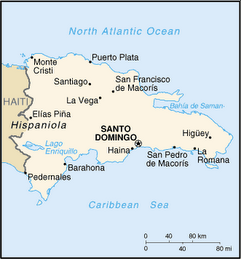
This past week the director of our Administrative Committee, Bob Smith, and a representative of the Committee on Relief, Mark Vance came to Santiago to meet with the people here. We had a day of meetings on Wed. including the seminary students, Rona-the Haitian pastor, several members of the church, and a visit to the Red Cross. After a busy day of meetings we began our trip to Jimani, the Dominican border town in the south that is close to Port au Prince.

We left Moca at 10:40PM with Juan Manuel as our Dominican driver (he is Alex's older brother), and he drives like a Dominican! We made it to Santo Domingo where we saw a HUGE convoy of military vehicles lined up at the toll booth. Most of us were trying to get some sleep but just when you almost fell asleep the van would hit a rough bit of road and bbbbrrrrrmmmm you would be rudely awakened, or we would hit a pothole (same result). So sleep came in small doses! Juan Manuel did know the way which made the drive quicker. We only had trouble in one spot where they had taken down the sign that was his landmark. We had to find someone awake (it was 3AM) to tell us which way to go. (We saw several watchmen and policemen sound asleep on their watches!).

We arrived in Jimani at about 5:30AM and decided to try to get some sleep in the van, while we were parked. That's when we all found out that SOMEONE snores!! So one person got a nice rest (where are the potholes when you need them?). Eventually a policeman came and told us we had to move the vehicle off the road, so we drove into the area where the international groups had set up camp. We found someone from the Defensa Civil who gave us some information about the situation in Haiti.

Everyone going into the country must now show their vaccination records. Everyone gets tetanus, rubeola vaccinations and malaria pills. These are the three main concerns at the present time. You are also warned against going into the country on your own. It is best to go along with a guarded convoy. Muggings and robbery at the border are quite a serious problem. During our conversation, we were informed about a hospital nearby that was caring for a large number of Haitians. We drove there to meet with the doctors.

The hospital was in two large houses that had been converted into hospitals. The first one was being used as the operating rooms and the second one housed the patients before and after their operations. We saw a constant stream of patients being brought in for surgery - most of them need amputations. The doctors explained that they do try to save the limbs, but many times the amputations are being done because of infections and gangrene. We also saw the area where they were receiving donations and Mark was able to contribute the medical supplies that he had brought along.

We walked down to the other building and saw many Haitians in various stages of healing. Because of the trauma of the earthquake, many of them have a fear of being inside a building. They are fearful of the building collapsing down on them - the children especially have this fear- so we saw many people who had dragged their mattresses outside and put up makeshift walls around them. While we talked and witnessed with some of the patients that spoke some Spanish, Rona began witnessing to them in Creole and spent a great deal of time trying to witness to them and give them some comfort and hope.

We started on our way back to Santiago and were enjoying a nice ride when we had a flat tire. We got the tire changed and then stopped in Santo Domingo to buy a replacement. There was a place not far from the highway that was open. The owner of the shop brought a used tire that was the right size and all SIX of the guys from the van examined the tire before a consensus was reached that this tire was acceptable. The new tire was put on and now we were ready for the last leg of the trip back to Santiago.

All in all, it was a very nice trip and we were able to accomplish our objectives: Rona was able to witness to some fellow Haitians, and Bob and Mark got the information they needed to set up further aid to Haiti via the possibility of volunteer WELS nurses and medical workers going to Jimani to serve there. We thank God for keeping us safe in all our comings and goings.

January 29, 2010

Obed Visits

Today we had a pleasant surprise when Obed came to visit during sem classes. He had a break at his work and was able to be in the DR for a few days and also was in Haiti visiting his family.

He went to see his parents who came through the earthquake fine. His brother, though, suffered the loss of his home and two of his children received injuries. When the earthquake hit his brother and his wife were not yet home so the children were alone. The oldest child, 11 yrs. old, was able to get all the children out of the house. But then they stood next to the building next door, about 3 stories high, which collapsed and two of the children were injured anyway. They took them to "Doctors Without Frontiers" who had already been working in the city and had their installations set up. The children were cared for and are recovering, but the parents could not find the children when they got home and it was not until the next day that they realized they were all alive and at the hospital.

Obed also talked about the violence in the country that is continually escalating. People are desperate to get food. Looting is rampant. He says that by 6PM everyone tries to find cover or shelter before it gets dark. He also referred to the kidnapping of children and thinks they will be most likely sold for organ trafficking. About five years kidnapping was a serious problem in Haiti and most of the children that were taken were sold for this purpose. The government made it a priority to get these kidnappers and many were put behind bars. Many of the people that were captured and put in jail have now escaped. It has been reported that 5,300 prisoners escaped in the earthquake. One Santiago newspaper ran a story about a Haitian woman who identified her rapist, here in the city, so we know they are crossing the border.

We asked him about the food situation. He said that there were some stores open but that all the prices had almost doubled. There also are no mechanisms in place for these stores to receive more supplies so they can only sell what they have in stock. We have noticed that the prices have also gone up in the DR. The government says that the provisions that are going to Haiti are surplus supplies and should not affect the availability of food here - but that is not the reality when you go to the store, especially in the poorer areas of town.

Other reports say that the Haitian hospitals are all out of morphine and analgesics, so they have nothing to give to their patients that have suffered amputations. The majority of the operations have been limb removal. The hospitals desperately need supplies: gauze, bandages, cotton, ibuprofen, antibiotics, intravenous solution, ... and the list goes on. The need is made worse by the fact that people are attacking UN convoys that are delivering supplies hoping to find food for their families.

In spite of all the tragedy and disaster we still find comfort and joy in our Savior's arms, remembering all he has done for us and rejoicing in his promises of forgiveness and eternal life when we leave this vale of tears. We continue to pray for wisdom and guidance in the midst of such sorrow and hurt and give thanks to a loving and merciful God who watches over His church and keeps us and guides in all His ways. It was with joyful hearts that we shared a devotion today with Rona and Obed and we give thanks to God for watching over them and their families.