Rains have drenched people in makeshift tents and homes have slid down hills with mudslides. Makeshift toilets were destroyed by the flooding, spilling sewage into the streets. The temporary schools were also washed away with the torrential rains. The rainy season will last until the end of May. The hurricane season is from June to November. (Haiti Star)
The government needs land for massive relocation. Approximately 1,500 acres have already been identified on the perimeters of the capital. But the government only own 50 acres and is currently in negotiations with private landowners. Commissioner Gerald Brun hopes that at least 80% of the cost of acquiring the land will be carried by the international community and lending organizations and that the U.S. would cover the rest.
The land has to be prepared and services provided. This could take weeks, months, even years. "Our biggest challenge has been lack of clarity about who are the decision makers". (Haiti Press)
Haitian President Rene Preval is calling for food aid to be stopped in favor of agricultural investment. For Haitians, near total dependence on imported food has been a disaster. Today Haiti depends on the outside world for nearly all of its sustenance. About 80% of all rice is imported. The country is unable to feed itself after years of relying on others for sustenance. "A combination of food aid, but also cheap imports have resulted in a lack of investment in Haitian farming and that has to be reversed", John Holmes, UN Humanitarian Chief.
Haiti's government is asking for $722 million to invest in agriculture. (Haiti Star)
The Dominican Republic has said it will donate 1,500 tons for seeds for Haiti to restart the farming industry. Ecuador has also donated 20,000 seeds for trees to be planted in the DR and Haiti in the following months. (Listin)
U. S. troops are withdrawing from Port au Prince, from 20,000 down to 8,000. Haitians are anxious that the most visible part of international aid is ending. U. S troops see their mission as completed: they provided emergency medical care, security, distributed emergency food and water rations, helped reopen the airport and seaport. The USNS Comfort has left after treating 8,600 patients. (Haiti Globe)
The Canadian army withdraws from Haiti with 2000 military personnel. As of today, there are less than 500 left in the country. They are handing security over to Non-governmental organizations. The last ones will be out by April 1. (Le Nouvelliste)
March 26, 2010


March 19, 2010
Haiti Herald, March 19, 2010
It's raining!! And the people are not prepared. First rain - then mud. The hard rain fell during the night. People tried to stay warm in their tents and in the morning had to deal with rivers of mud. It is estimated that another 200,000 tents are needed for the earthquake victims. The participants of the Conference held in Santo Domingo this past week pledged 70,000 more tents. They are hopeful that the summit in New York on March 31 will be able to find the remaining 130,000. (Le Nouvelliste)
Five areas have been approved by the government as lodging camps for earthquake victims and 8 other lots have been designated for rubble areas. The first camp would be located 15 km outside of Port au Prince with room for 10,000 people. These new cities would be equipped with police, parks, clinics and bathrooms. The government has also initiated a program to inspect housing that was not damaged in the quake to allow people and businesses to move back into their buildings. (Haiti en Marche)
Still no formal date for the reopening of school. Some classes are being given in tents. It is not officially called "school" but academic activities. This is seen as a method to help children adapt to a routine of school-like activities. Students are grouped by their level of academic ability and not by age. The goal is to get them involved in mental activities to keep their minds active. (Haiti Press)
Marie Brutus wrote an article in Le Nouvelliste in which she described the dilemma of the Haitian doctors. "It is urgent and important to help the wounded, but we also need to think about the doctors from here. The foreign doctors came in great numbers and with a great amount of free medicine so that now a Haitian surgeon or orthopedist cannot find anyplace to work or practice. Nevertheless, these doctors have family responsibilities but they don't have international aid to pay them long-term. And even as we recognize the need for the international aid, you must admit that long term - since the aid will only continue a few more months, maybe a year- this situation will be disadvantageous for Haitian professionals. This aid will have a negative effect on our medical students and young doctors who, not seeing any future in their field, will leave the country at a time when the country needs them the most.
Whereas the foreign medical aid is abundant and on one hand is necessary for the population, on the other hand Haitian doctors are worried about the future. The personnel from some hospitals is already disposable since these hospitals, not generating any profit, cannot pay the doctors. What will happen to these doctors once the fever of the earthquake has passed? What will happen when the foreign meds smother the local health sector? What will happen to the Haitian doctors, once the international medical aid has totally absorbed (or almost) all of our clientele?" (Le Nouvelliste)
March 15, 2010
"I will bless them"
Sundays are al ways the highlight of the week as it gives us the opportunity to hear God's Word with the whole community of believers and to enjoy the fellowship of other Christians. The public worship service also gives each of us the privilege of serving others through words of encouragement and the joy of giving an offering for the work of extending the gospel.
This past Sun day was especially exciting in two ways. In the morning service at Moca, a new member was received through the sacrament of baptism. Pastor Alex gave a beautiful message reminding all of us of our need for baptism because of our sinful nature, and of the blessings of the water connected with the Word. What joy for every member to be reassured of their forgiveness, but especially for our newest member, received into the family of God and made an heir of heaven.
In the a fternoon service at Pueblo Nuevo, Pastor Juan received a new member into the congregation through the rite of confirmation. Patricia confessed her faith publicly before the congregation and was received as a new member of "Soldados de Cristo". The Lord constantly pours out His blessings on us and on his people and moments like these remind us of His work among the people, creating faith in hearts and drawing more souls to him to be his forever.
 ways the highlight of the week as it gives us the opportunity to hear God's Word with the whole community of believers and to enjoy the fellowship of other Christians. The public worship service also gives each of us the privilege of serving others through words of encouragement and the joy of giving an offering for the work of extending the gospel.
This past Sun
 day was especially exciting in two ways. In the morning service at Moca, a new member was received through the sacrament of baptism. Pastor Alex gave a beautiful message reminding all of us of our need for baptism because of our sinful nature, and of the blessings of the water connected with the Word. What joy for every member to be reassured of their forgiveness, but especially for our newest member, received into the family of God and made an heir of heaven.
In the a
 fternoon service at Pueblo Nuevo, Pastor Juan received a new member into the congregation through the rite of confirmation. Patricia confessed her faith publicly before the congregation and was received as a new member of "Soldados de Cristo". The Lord constantly pours out His blessings on us and on his people and moments like these remind us of His work among the people, creating faith in hearts and drawing more souls to him to be his forever.
March 11, 2010
Exploratory Work

Rona returned from his first two-week exploratory trip to Haiti. He had found his family members and visited with them both in Cap Haitian and Port au Prince. They are all doing fine and are waiting to see how the government will remedy their housing situation. Finding food is still a difficulty and most people spend many hours waiting in lines for coupons and for groceries.
Rona's objective
 on these trips into Haiti is to make contacts to see about the viability of starting a group in one of the cities. He handed out many copies of "The Promise" in Creole and in French. When he goes back on future trips, he will see if he is able to locate these people again (besides his family). The people in Port au Prince may be relocated by the government into smaller and more manageable "tent cities" so finding them again may be difficult. Cell phone service is still unreliable and electricity is also frequently out.
In other news, we made a trip down to Santo Domingo this past week to renew some of our legal papers. To b
 e legal, we need to maintain an ID card and also a residence card. The residence card is a must for entering or leaving the country. The ID card is usually needed for banking or credit card transactions. The whole process, including the two hour trip (one way) to the capital, took eight hours and cost about $100 each. This is really quite smooth in comparison to other countries where we have lived and we were thankful there were no complications. These cards are valid for another two years.
March 5, 2010
Haiti Herald, March 5, 2010
Madame Kim Bolduc, a representative of the UN, said "People expect Haiti to be better this time around. With the amount of solidarity Haiti has received from all over the world, we will do better this time". (Haiti Globe)
This is a partial list of the solidarity that is coming to Haiti:(from Financial Edge)
U.S. $100 million, rescue teams, Coast Guard assistance, port assistance, medical ships
Guyana $1 million
Norway $17.5 million, also set up a Red Cross hospital
Trinidad and Tobago $1 million
Australia $10 million
Britain $10 million, 71 rescue specialists
South Korea $1 million
Finland $1.8 million
The European Union will donate $135 million for government buildings and schools (this is only a third of what they will be donating).
Brazil will help Haiti develop a hydro-electric power project.
Costa Rica and Dominican Republic have offered to help reforest Haiti. (El Nacional)
Irish telecommunication company Digicel will donate $5 million to repair the phone network.
On the health front, there have been 11 confirmed cases of malaria among emergency medical personnel (Haiti Star). There are more cases expected with the rains that are coming regularly since last week. There have also been several cases of leptospirosos, a rare and severe bacterial infection. (Haiti Globe) This disease is generally thought to be caused by rat urine or feces in food. The rains will also facilitate the spread of this disease.
Now that it is raining, the rains will run through the rubble still remaining throughout the city. In this rubble there are still many decomposing bodies. The flow of rain will carry this contaminated water through the streets of the camps. The sanitary and health problems seem insurmountable. Rains weren't expected to begin this soon, the heavy showers of last weekend soaked many and caused 13 deaths.
Tents were purchased this week from China. People need tents but Charles Clermont, Presidential Counsel for Housing Commission says there isn't enough free room to set up another 200,000 tents in Port au Prince. Many are also saying that the tents are too expensive for a temporary solution: too hot when the sun shines and not enough protection when it rains, and only a temporary solution. Most of the families currently using tents will need housing for 3-5 years. At $100 - $150 per tent, Clermont suggests using these funds to purchase shelter kits instead. Each kit comes with sheets of tin, posts and other building materials.
Another complication caused by the tents is the fire hazard they pose. Since there is no electricity, people are cooking on open fires outside their tents and using wax candles for light at night. (Le Nouvelliste)
Homes that are still standing are being inspected to insure that they are safe for people to move back in. But with the earthquake of last week (4.7), people are more afraid than ever to live under any kind of cement or brick roof. Many who were inside their homes have decided to sleep outside because of safety concerns.
March 1, 2010
San Pedro Celebrates 5 Years

This Feb. the congregation, "El Amor de Jesucristo Lo Vence Todo", celebrated their fifth year anniversary of the dedication of their building. In a joyful worship service, Pastor Julio Corporan emphasized their thankfulness for being brought to know the truth and he encouraged the members to continue living lives of gratitude to their Savior.
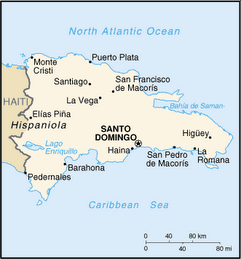
San Pedro is on the southeast end of the island. By far, the poorest of the Lutheran con
 gregations in the Dominican Republic, they are rich in witnessing. This small group, though it has meager offerings, does a great deal of outreach. They have contacts and small groups in such cities as La Romana, Quisqueya, and Higuey and are also working in several barrios within the city of San Pedro itself: Barrio Lindo, Honduras and in several outlying bateys (where the cane workers live).
What a joy to
 hear them speak of their witnessing opportunities and what an even greater joy for them to share the Savior with others. May the Holy Spirit help us to do the same.
February 23, 2010
Haiti Herald, Feb. 23, 2010
There was another earthquake in Haiti on Monday. It was reported to be 4.7 but was strong enough to panic the people. It has been reported that there have been 130 aftershocks since the major 6.1 earthquake of Jan. 12. (Le Nouvelliste) President Preval now estimates the number of victims to be as high as 300,000 once all the rubble has been removed and all bodies have been rescued.
Two minibuses loaded with aid that had been donated to the Haitian earthquake victims were stopped in Dajabon, DR. The goods were being brought into the DR to be sold here for profit. The buses contained clothing, mosquito nets, toothpaste, shoes and food with the labels from the international aid agencies still on them. Another vehicle completely full of canned food was also stopped and confiscated by police.
A UN convoy of food was attacked near Cap Haitian on Monday. The convoy had crossed the border in the northern part of the country and was headed to Port au Prince. A crowd of over 100 people blocked the road and threw rocks at the convoy, demanding aid for them and their families. Under pressure, the Chilean soldiers accompanying the convoy distributed the food to the protesters. (SF Gate)
Dominican police have also stopped several truckloads of illegals crossing the border. The Haitians said they paid $150-200US to be transported from Port au Prince to Cap Haitian. From there, Haitian traffickers got them across the border and then asked them for $3000-4000 Dominican pesos to take them to Santiago. The trucks were carrying 127 Haitians. (Listin Diario)
Haitian senators have asked President Preval to extend for another month the "state of national emergency" which has now ended. There is still $11 million US available to be distributed under the emergency plan that could be used to help people who are still in critical situations. The senators asked for these funds to be spent rapidly and without constraint. (Le Nouvelliste)
The Haitian ambassador to Spain said this week that it will take 25 years to rebuild Haiti. She is asking Spain to donate tents and prefabricated houses. An estimated 20,000 homes were destroyed in the quake. She is also asking Spain to donate large machinery to help in the demolition of damaged buildings and in the removal of rubble. (Listin Diario)
A serious concern in the tent cities is what to do with all the human waste. Cases of typhoid and diharrea are on the rise. There are no sewage system treatment plants in Haiti. Human waste is dumped in the city dump along with garbage and medical waste. There are some portable latrines but even these overflowed after the rains of the past week. Aid workers are looking for more portable latrines but that also means setting up a system and paying someone to regularly empty them. (SF Gate)
All of the country's embassies have been inundated with people asking for travel visas. Haitians stand in line from sunup to sundown, in the rain and in the sun, waiting for their number to be called. Many will even sleep on the sidewalk overnight so as not to lose their place in line. The most coveted visas are for Canada, USA, France, Mexico and Senegal. (Le Soleil)
Dr. Michel Chancey, Haitian Secretary of State, responsible for the distribution of food donations in Haiti warns that too much aid will only slow down Haiti's economic redevelopment. The constant flow of free food will make if difficult for farmers to market their products. The planting season begins next week, but many farmers are discouraged about planting since they fear no one will buy their products if they are able to receive them free in a handout line. The government is distributing 10,000 tons of rice every two weeks. Chancey said that before the earthquake Haiti produced 45% of it's own food, imports were 50% and 5% was international aid. Before the earthquake 500,000 were receiving food aid. That number is now 2 million. Chancey would like to see a gradual reduction of the food aid so the country can reestablish it's agriculture system and reduce the dependence on international food aid. (Le Soleil)
February 20, 2010
Ronany

Ronany, the daughter of Rona Abraham, turned one this month. She was born here in Santiago and has papers as a Dominican citizen. Her parents had a small get together to celebrate.

She enjoyed the cake and the toys and for the most part is a very pleasant and happy one year old.

Rona is a very proud and happy father. Now that he is making two week long trips into Haiti to do exploratory work, he will not see very much of his daughter. Ronany and her mother will be staying here in Santiago.
February 18, 2010
Haiti Herald, Feb. 18, 2010
The rains are coming early this year. There have already been several heavy downpours, causing fear and panic among the people and making even more desperate the need for stable housing. An estimated 600,000 people still do not have "tents" (more than just cotton sheets). The rains have an adverse effect on the amputees as their injuries make it difficult for them to avoid the rains or move quickly. If it rains hard there is no place for the rain water to go - it stagnates, becoming a breeding ground for mosquitoes. Once it starts raining, belongings will not have a chance to dry out and mold will develop. The rains also cause despair and anger among the refugees.
On Monday a school collapsed in Cap Haitian after a heavy rain with high winds. Four children were killed. (Le Nouvelliste) The Haitian government would like to have more schools permanently open by March, but many children are still traumatized by the earthquake. They are afraid to be away from their parents or to be under any kind of ceiling. Schools outside of Port au Prince have reopened but many children are not attending.
The Port au Prince airport will recommence commercial flights this coming Friday. Since the terminal was severely damaged in the earthquake, they will only be operating from a portion of the terminal. There are approximately 1,000 planes still on a waiting list to land with donated aid.
Several countries have offered to rebuild the government buildings. France, Canada, Brazil and Chile have all presented plans for reconstruction in Port au Prince with an average cost of $12 million US to get things started. The President and his Cabinet are currently working out of the airport police station. (Haiti United Press).
President Preval estimates that it will take 1000 trucks working every day for 1000 days - just to remove all the rubble - three years. (Press Network)
February 13, 2010
Fellowship Service
Leaders of Haiti's two official religions, a Catholic bishop and the head of the Voodo priests - joined Protestant ministers for a prayer service near the National Palace. A Muslim preacher also attended. (Haiti Press)
A Day of National Mourning was declared for Feb. 12. Catholics, masons, muslims and voodooists were all invited to participate.
A voodoo priest said to the congregation that the earthquake was a time to unify all faiths. (Haiti Globe)
A woman sang a song honoring the snake spirit.
** ** ** ** ** ** ** ** ** ** ** ** ** ** ** ** ** ** **
It is always surprising that people who talk about the Scriptures as the truth can believe that joining together with those of other faiths is pleasing to God. The entire Old Testament teaches us how God patiently tried to teach his chosen people to remain separate, to guard the truth as their most precious treasure, to not mix it with the pagan practices they saw around them.
When we see the massive crowds of people all joined together, people of all faiths joining in a worship service, it does fill us with emotion and we want to feel satisfaction at people coming together working for the good of man. We know, though, from Scripture that these types of joint services are not pleasing to our faithful God. His truth is not to be contaminated with false teaching. He still calls on us to guard his truth and to keep it pure from false teachings.
Daniel faced a test when the king built a statue and ordered everyone in his kingdom to bow down before the statue. Daniel, in faithfulness and worship to God alone, refused to join in any kind of worship contrary to God's will. He refused to obey the king's orders even though it meant a death sentence for him. He put his service to God above the friendship of men.
What can we think, then, when we see these massive groups of people joining together in an ecumenical service? It causes us great sadness. In their desire to seek peace with men and obtain God's favor in ways contrary to God's will, these leaders and their followers are rejecting the peace with God that He wants to give them through faith in Jesus. And if they do not repent and trust only in Jesus as their Savior, in the end they will bring the wrath of God down on themselves. That would be a far greater tragedy than the earthquake. We pray that the hearts of the people in Haiti would be opened to know the truth of the Scriptures. Rona Abraham (our Haitian pastor) is currently in Haiti doing exploratory work to begin mission work there. Please pray with us that God would bless his efforts and bring people to believe the truth of his Word. God will not share his glory with another and he will not be mocked.
Subscribe to:
Posts (Atom)

 Posts