Registering the Population
The OAS has begun developing a civil registry in Haiti that includes minors and children. The most basic elements of social and economic planning and development require a clear accounting of the population and their location. This process was started five years ago and more than 4 million adults had been registred when the earthquake hit on Jan 12. Efforts have been renewed since Jan. and some 1,500 children and their parents or guardians have been registered so far. (Caribbean News)
Relocating the Homeless
President Preval underscored the relocation of the homeless as a priority before the beginning of the hurricane season. But he has not found the magical formula to carry it out.
Relocating the homeless has become worrisome for the Haitian government and the international organizations intervening the the post-disaster activities. Many strategies have been studied, but none so far offers the desired effects.
People are being allowed back into their homes once they have been inspected. Some 40% of the homes in Port au Prince are still habitable. Some people who could be back in their homes refuse to return prefering to live in the camps where they can take advantage of receiving water, food and sanitary facilities.
7,000 homeless were forcefully removed from the soccer stadium. Another 245,000 are in danger of flooding during the rainy season. Seven tent sights have been declared high risk areas. Government officials make regular visits to these areas urging the people to consider moving. President Preval says that housing is his first priority. "Relocating 1.3 million people who sleep on the streets will take time and will be costly. We have started with those who faced the greatest danger. The reconstruction is going to take a long time". (Le Matin)
(The following is an article that explains a little about how the political system works in Haiti. It is a bit lengthy but I found it to be very instructive about insights into how the country is functioning).
Haiti and its flawed electoral process!
By Jean H Charles
The Haitian Constitution stipulates that regular presidential elections shall take place every five years on the last Sunday of November, with a presidential inauguration to take place on the following February 7, to correspond ab eternum to the day the Haitian people delivered themselves from the Duvalier dictatorial regime.
The earthquake of January 12, 2010, has destroyed the capital city of Port au Prince as well as surrounding cities of Jacmel, Leogane, Petit Goave and Grand Goave, with more than 1.7 million people sleeping under a tent, sometimes in the rain amidst squalor and the mud. Vital records have been destroyed, the dead have been cremated without proper state sponsored identification and the Preval government has exhibited a culture of deception, corruption, and perversion of the electoral process. It is a perfect storm to create a disaster in lives lost in the next few months. It is also the perfect tool for maintaining the status quo through a flawed electoral process. Yet the international community, through the voice of the OAS Assistant Secretary General Albert Ramdin, the United Nations representative Edmond Mulet, the CARICOM delegate PJ Patterson, is pushing full speed ahead for a flawed election to take place under the baton of Rene Preval, a master mind of cunning, double talk, and plain disregard for the plight of the majority of the Haitian people.
May 18 commemorates the weaving of the flag made with the blue and red piece of cloth from which the white piece symbolizing colonial France has been extirpated. On this very day of celebration, the people of Haiti are demonstrating en masse, on the street demanding the forced departure of the Preval government so they can go on with their lives, and ensure a fairly clean election. Will Preval and the international community, through misguided policy, succeed in maintaining a status quo that will lead to disaster in the coming months of the hurricane season with millions of people at risk? Or will the Haitian people succeed in forging a new order of business in running the Republic of Haiti?
Haiti has been sinking deeper into bigger risk in food security, diminution of human life protection and severe environmental degradation. The international community has responded with unusual humanity and compassion to the earthquake-stricken Haiti with ten billion dollars, the corrupt regime and the partisans of the status quo will easily sink $100 billion with no apparent result for the Haitian people. They have discovered a brand new concept: disaster profiteering.
Not one of the 565 rural hamlets of Haiti has received any funding for infrastructure and institution building. Seven million Haitian people out of the 9 million population live in extreme misery, neglect and ostracism from their own government.
May 28, 2010


May 22, 2010
Faithful Leaders

This month we were privileged to celebrate the birthdays of two of our leaders.
The mens club got together and gave Philip a surprise party.

The congregation gave Pastor Alex a surprise party after Bible study.
What a blessing it is when God allows us to have faithful leaders that teach us His Word, not only in classes but also in their daily lives. This is another example of God working among the people as He preserves His work by strengthening the leaders, giving them hearts dedicated to spreading the gospel and seeking the lost.
May 15, 2010
Haiti Herald, May 15, 2010
Manifestations Demand the Resignation of Preval
Protesters are demanding that President Preval resign. His term was due to end in Feb. but presidential elections may not be held until Nov. because the earthquake destroyed voting records and polling places.
The entire lower house and one-third of the senate are no longer sitting because the earthquake prevented Feb. legislative elections from taking place. Effectively, the parliament is ceasing to exist as a governing body. This concentrates power in the hands of the President and the international commission that has been set up.
The commission, co-chaired by former President Clinton is to oversee the $9.9 billion US for foreign reconstruction, money pledged at a March conference, a sum 40% larger than Haiti's entire gross domestic product.
Many protesters say that Preval has sold the country to foreign powers, while the commission violates Haiti's sovereignty. (Haiti Globe)
Four months after the quake, and people are still living in tents. "We've heard that foreigners have given lots of aid money. But we are still living the same way as before, and we're still dying the same way," said Davery Nulmeus. Haiti's needs are still enormous, but more than 100 days after the quake, the plan for dealing with them is unclear. (Haiti Press)
Reconstruction Blackout (Haiti En Marche)
The earthquake killed 300.000 people and destroyed 500,000 homes. With international aid, the government is taking inventory of the losses. Some buildings are a total loss, others need to be demolished. Some can be repaired but need to be reinforced to prevent hurricane damage or further damage from more earthquakes.
But while we wait, those who are in charge have been totally vague. No one seems to know what to do.
No one knows what Port au Prince will look like in 6 months, one year or ten years - or even if the capital is condemned to remain in its present state. At this stage, nothing seems impossible. In any case, the Reconstruction that everyone else is talking about seems to be a foreign word for the administration.
The people await their words of wisdom. Everyone realizes they need to be understanding of the difficulty of the situation, even those who have the means to begin reconstruction. But the officials continue in their silence.
Even if they don't know the agenda for the future projects, they at least have some idea of what is being planned. They would do well to inform the population - if only to be able to inform them that they will not continue living in this situation indefinitely, to give them some spark of hope that there will be some kind of order in this monstrous cacophony that reigns now in the capital.
Who knows what the capital could look like after this huge earthquake that affected each and every one of its inhabitants? This is the subject of conversations in all of Haiti. Rumors are flying. But the people involved are the last ones to know.
The people are forced to get their information from foreigners. The people being affected are the last to know. That is the rule in Haiti.
So everyone tries to keep on hoping. Do the people who actually live here have a voice in the plans? A city should be built for its inhabitants and not just for the pleasure of building.
We need to reawaken the spirit of being a good neighbor, not just trying to protect our own territory. The people dream about a change.
We hear people say all the time: "If I rebuild, and the the State decides to put a community center next to my house - behold the chaos".
With regard to the Reconstruction, it seems that everyone's mouth has been sewn shut.
Until now the population has remained calm. But if the hurricane season causes another catastrophe, the absence of information will leave the people only one choice, as a popular refrain says: Each one for themselves and all for God.
And that will be the end of everyone's dreams.
(This article taken from Haiti En Marche, May 12, 2010)
Protesters are demanding that President Preval resign. His term was due to end in Feb. but presidential elections may not be held until Nov. because the earthquake destroyed voting records and polling places.
The entire lower house and one-third of the senate are no longer sitting because the earthquake prevented Feb. legislative elections from taking place. Effectively, the parliament is ceasing to exist as a governing body. This concentrates power in the hands of the President and the international commission that has been set up.
The commission, co-chaired by former President Clinton is to oversee the $9.9 billion US for foreign reconstruction, money pledged at a March conference, a sum 40% larger than Haiti's entire gross domestic product.
Many protesters say that Preval has sold the country to foreign powers, while the commission violates Haiti's sovereignty. (Haiti Globe)
Four months after the quake, and people are still living in tents. "We've heard that foreigners have given lots of aid money. But we are still living the same way as before, and we're still dying the same way," said Davery Nulmeus. Haiti's needs are still enormous, but more than 100 days after the quake, the plan for dealing with them is unclear. (Haiti Press)
Reconstruction Blackout (Haiti En Marche)
The earthquake killed 300.000 people and destroyed 500,000 homes. With international aid, the government is taking inventory of the losses. Some buildings are a total loss, others need to be demolished. Some can be repaired but need to be reinforced to prevent hurricane damage or further damage from more earthquakes.
But while we wait, those who are in charge have been totally vague. No one seems to know what to do.
No one knows what Port au Prince will look like in 6 months, one year or ten years - or even if the capital is condemned to remain in its present state. At this stage, nothing seems impossible. In any case, the Reconstruction that everyone else is talking about seems to be a foreign word for the administration.
The people await their words of wisdom. Everyone realizes they need to be understanding of the difficulty of the situation, even those who have the means to begin reconstruction. But the officials continue in their silence.
Even if they don't know the agenda for the future projects, they at least have some idea of what is being planned. They would do well to inform the population - if only to be able to inform them that they will not continue living in this situation indefinitely, to give them some spark of hope that there will be some kind of order in this monstrous cacophony that reigns now in the capital.
Who knows what the capital could look like after this huge earthquake that affected each and every one of its inhabitants? This is the subject of conversations in all of Haiti. Rumors are flying. But the people involved are the last ones to know.
The people are forced to get their information from foreigners. The people being affected are the last to know. That is the rule in Haiti.
So everyone tries to keep on hoping. Do the people who actually live here have a voice in the plans? A city should be built for its inhabitants and not just for the pleasure of building.
We need to reawaken the spirit of being a good neighbor, not just trying to protect our own territory. The people dream about a change.
We hear people say all the time: "If I rebuild, and the the State decides to put a community center next to my house - behold the chaos".
With regard to the Reconstruction, it seems that everyone's mouth has been sewn shut.
Until now the population has remained calm. But if the hurricane season causes another catastrophe, the absence of information will leave the people only one choice, as a popular refrain says: Each one for themselves and all for God.
And that will be the end of everyone's dreams.
(This article taken from Haiti En Marche, May 12, 2010)
May 9, 2010
Sound the Trumpets!

Trumpets are sounding, angels are rejoicing, Christians are giving glory to the Savior.
Today, through the sacrament of Holy Baptism, the Holy Spirit fulfilled the promise of forgiveness and faith in the hearts of three children. What a blessing as all three children received the blessings promised in the Word.
What a joy for all of the members who were present at the baptisms. Faith was strengthened and comfort given as we continue to see God working among the people. He is the one creating faith in the parents hearts, leading them to believe the promises and bring their children for baptism. Why else would someone want their children to be baptized? D
 oesn't society teach us that we are basically good, that children are innocent, not guilty? The rite of baptism is a witness to the world that we believe what God says in His Word, that our children are sinful beings that need His forgiveness and washing of their sins. It is a witness of our trust in God to fulfill His promises in the lives of these young ones. They are now His children.
When the sacraments are practiced they are a blessing for all present. Those who participate receive the promised blessings. Those who only observe are also blessed by hearing the Word and remembering how God worked this faith in them also. With thankful and humble hearts we recognize that this gift comes to us purely by God's grace since we have not and do not do anything to
 deserve it.
What a wonderful day for the Christian church. Sound the trumpets! Give praise to God! He is working among the people: creating, strengthening and preserving them in faith through the power of His Word.
Arise, be baptized, for the forgiveness of sins and you will receive the gift of the Holy Spirit.
April 24, 2010
Tents

Another common theme among the Haiti pictures
 are the tents. At first glance, many of the pictures seem similar and you may think you are seeing the same thing. Rona explained that after the earthquake all the parks in the city were taken over by survivors. What you are really seeing are different tent cities in different parks around the city.
People prefer these park areas since they usually offer a bit of shade from the hot sun.


This is one park that was closed off to keep people out. City officials hope to preserve the park.

This is the "family" tent. Rona's family sleeps in this tent at night since they are afraid to go back into their house until it has been inspected.
April 23, 2010
Lines in Haiti
Rona shared some of his photos from his various trips into Haiti. Here a few that give an idea of what people's daily lives are like since the earthquake.

This is the food line. To receive food, you must first stand in line to receive a coupon. Once you have the coupon you are eligible for a food ration. The system for receiving the food is not very organized. There is only ONE line, no matter how many people are in that line. (Rona said it could be up to 2,000 people in line). Everyone must wait in the hot sun until it is their turn. This can mean ALL day until your turn comes.

There are also lines for water. This water is for cleaning and washing, but not for drinking.

Stand in line to receive medical care. There are clinic tents set up in different parts of the city. Some were placed under trees and have shade. Those that don't have any shade turn into saunas when the sun beats down.

Work line. Some international organizations offer to pay $5 a day to workers who are willing to help clear rubble. Workers are also allowed to scavenge for materials that they could use for the reconstruction of their own houses.

This is the food line. To receive food, you must first stand in line to receive a coupon. Once you have the coupon you are eligible for a food ration. The system for receiving the food is not very organized. There is only ONE line, no matter how many people are in that line. (Rona said it could be up to 2,000 people in line). Everyone must wait in the hot sun until it is their turn. This can mean ALL day until your turn comes.

There are also lines for water. This water is for cleaning and washing, but not for drinking.

Stand in line to receive medical care. There are clinic tents set up in different parts of the city. Some were placed under trees and have shade. Those that don't have any shade turn into saunas when the sun beats down.

Work line. Some international organizations offer to pay $5 a day to workers who are willing to help clear rubble. Workers are also allowed to scavenge for materials that they could use for the reconstruction of their own houses.
April 15, 2010
Haiti - Three Months Later
Reconstruction - Are We All Speaking The Same Language? (from Haiti En Marche)
President Rene Preval gave a press conference in NY. Questions from the national press and international press are not the same. Foreigners are focused on preparing the refugees for the oncoming hurricane season. The President can answer easily enough that the government will appropriate lands outside the capital to relocate thousands now living in tents. But, what about the rebuilding and helping the people not receiving food, medicine and tents? In regard to the rebuilding of the capital, the government has not made any statement.
What do we mean by reconstruction - really? Who gets what? Can we rebuild all the houses in Port-au-Prince that were destroyed by the earthquake? What are the conditions for rebuilding? Who funds it?
When we start talking about rebuilding we need to get the banks open and operating. The banks need to give out credit, but how can the banks recover their own losses when their buildings were not insured? What about private homes? There is no precise answer.
While the US press talks of a Reconstruction Commission overseen by former president Clinton and Haitian Prime Minister Jean Max Bellerive, President Preval says these plans are all very premature. The only thing we know for sure is that the World Bank will handle the reconstruction funds.
* * * * * * *
What is really happening in Haiti? Rona Abraham came back from Cap Haitian t his past week. He had spent two weeks in the neighboring country doing evangelism work and visiting his family. He showed us a receipt for medications (see photo) for his cousin who had been hurt in the earthquake. When he went to the pharmacy to get the medicines - he had to pay for medicines that had been donated for earthquake victims! You can see the stamp on the left side of the receipt PAYE (paid). When they questioned the workers as to why they were charging for these medicines, they just shrugged their shoulders. He says that food and tents that have been donated for victims are also being sold.
* * * * * * * *
The first group of victims was to move to the new government camps on April 15.
Aided by the UN and the US Army, Camp Corail should be ready to receive 8,000 people. The camp is 20 km (45 min) north of Port au Prince. People are hesitant to move to the new camp, only a few showers and latrines have been installed, about 20 large white tents, the school is still under construction, camp management is just getting underway. The move is planned to begin on Sunday. Everyone who stays in the new camp will receive $50 - after staying for two weeks.
(Haiti En Marche)
President Rene Preval gave a press conference in NY. Questions from the national press and international press are not the same. Foreigners are focused on preparing the refugees for the oncoming hurricane season. The President can answer easily enough that the government will appropriate lands outside the capital to relocate thousands now living in tents. But, what about the rebuilding and helping the people not receiving food, medicine and tents? In regard to the rebuilding of the capital, the government has not made any statement.
What do we mean by reconstruction - really? Who gets what? Can we rebuild all the houses in Port-au-Prince that were destroyed by the earthquake? What are the conditions for rebuilding? Who funds it?
When we start talking about rebuilding we need to get the banks open and operating. The banks need to give out credit, but how can the banks recover their own losses when their buildings were not insured? What about private homes? There is no precise answer.
While the US press talks of a Reconstruction Commission overseen by former president Clinton and Haitian Prime Minister Jean Max Bellerive, President Preval says these plans are all very premature. The only thing we know for sure is that the World Bank will handle the reconstruction funds.
* * * * * * *
What is really happening in Haiti? Rona Abraham came back from Cap Haitian t
 his past week. He had spent two weeks in the neighboring country doing evangelism work and visiting his family. He showed us a receipt for medications (see photo) for his cousin who had been hurt in the earthquake. When he went to the pharmacy to get the medicines - he had to pay for medicines that had been donated for earthquake victims! You can see the stamp on the left side of the receipt PAYE (paid). When they questioned the workers as to why they were charging for these medicines, they just shrugged their shoulders. He says that food and tents that have been donated for victims are also being sold.
* * * * * * * *
The first group of victims was to move to the new government camps on April 15.
Aided by the UN and the US Army, Camp Corail should be ready to receive 8,000 people. The camp is 20 km (45 min) north of Port au Prince. People are hesitant to move to the new camp, only a few showers and latrines have been installed, about 20 large white tents, the school is still under construction, camp management is just getting underway. The move is planned to begin on Sunday. Everyone who stays in the new camp will receive $50 - after staying for two weeks.
(Haiti En Marche)
April 12, 2010
Easter

He is risen - Just as He said.
Easter is not a big holiday in Latin America - Good Friday seems to get all the attention. Many people remember Jesus' suffering but then do not rejoice in His victory.
For us, Easter is the highlight of our faith. Our Savior has left the tomb empty - victorious. The churches in the DR celebrated this Easter by showing our new WELS movie, "The Road to Emmaus". Pastor Alex showed the movie in Moca in the morning and Pastor Juan shared it with his congreg
 ation in the afternoon in Pueblo Nuevo.
People enjoyed the movie and we hope it will be used for further outreach and evangelism. Many new people were already present for the two showings and members have many more friends with whom they would like to share the movie. We are thankful for these kinds of resources to aid in evangelism, especially since we have found that videos are a very popular method of learning in Latin America.
April 8, 2010
Haiti Herald, March 8, 2010
Restoring agriculture is seen as crucial to help Haiti feed itself and to provide jobs. The Haitian government estimates that it needs $1 billion over the next decade to revive the agricultural sector. - Brazilian scientists are developing 50 acres to plant corn, rice and beans. - The UN Food and Agricultural Organization has started a cash-for-work program to help farmers replace 20-30,000 wheelbarrows, shovels and other equipment that were lost in the earthquake. (Haiti Globe)
School will officially open on April 5. The Ministry of Education encourages all schools that are able to re-initiate classes. New school calendars and programs will be distributed by the government to help teachers get back on track. (Haiti Press)
Now that the government has officially set a date for reopening schools they face a new dilemma - what to do with the refugees living on the school grounds? Will they force refugees to leave school premises? Where will they go? The new camps are not ready. Refugees refuse to abandon the schools - the only safe place they have to live. "If necessary we will defend ourselves. We are ready to burn tires if they come in". The refugees are already organized in the camps where they are living. Many receive weekly humanitarian aid that they would lose access to if they moved to a different area of the city. Medical services are also readily available where they now live. (Haiti Press)
Rubble from the quake will be used to rebuild the capital. Officials plans to reuse much of the debris being cleared away from collapsed buildings. About 90% of the construction debris can be recycled. The debris from the Jan. 12 quake is enough to fill the LA Superdome - 5 times. (Haiti Star)
According to it's own estimates, the government of Haiti pegged funds needed to rebuild the nation at $4 billion. Donor nations have already committed more than $5.3 billion over the next two years. The international monies will be used to build hospitals, schools and government buildings.
Update: Schools did not reopen on April 5 as planned. Most schools are still rebuilding. The majority of the larger schools were severely damaged. Of those that did not collapse, most students are too fearful to enter and refuse to do so. The adopted solution is to rebuild. New schools are being built of wood with tin roofs - leaving most of the side walls open. The new date for reopening of schools is next week -- maybe. (Haiti Press)
School will officially open on April 5. The Ministry of Education encourages all schools that are able to re-initiate classes. New school calendars and programs will be distributed by the government to help teachers get back on track. (Haiti Press)
Now that the government has officially set a date for reopening schools they face a new dilemma - what to do with the refugees living on the school grounds? Will they force refugees to leave school premises? Where will they go? The new camps are not ready. Refugees refuse to abandon the schools - the only safe place they have to live. "If necessary we will defend ourselves. We are ready to burn tires if they come in". The refugees are already organized in the camps where they are living. Many receive weekly humanitarian aid that they would lose access to if they moved to a different area of the city. Medical services are also readily available where they now live. (Haiti Press)
Rubble from the quake will be used to rebuild the capital. Officials plans to reuse much of the debris being cleared away from collapsed buildings. About 90% of the construction debris can be recycled. The debris from the Jan. 12 quake is enough to fill the LA Superdome - 5 times. (Haiti Star)
According to it's own estimates, the government of Haiti pegged funds needed to rebuild the nation at $4 billion. Donor nations have already committed more than $5.3 billion over the next two years. The international monies will be used to build hospitals, schools and government buildings.
Update: Schools did not reopen on April 5 as planned. Most schools are still rebuilding. The majority of the larger schools were severely damaged. Of those that did not collapse, most students are too fearful to enter and refuse to do so. The adopted solution is to rebuild. New schools are being built of wood with tin roofs - leaving most of the side walls open. The new date for reopening of schools is next week -- maybe. (Haiti Press)
April 3, 2010
Good Friday 2010

On Friday afternoon, the members of the Moca congregation invited their friends and neighbors to come and watch "The Passion of the Christ" with us at the church. All the benches and chairs were set up.
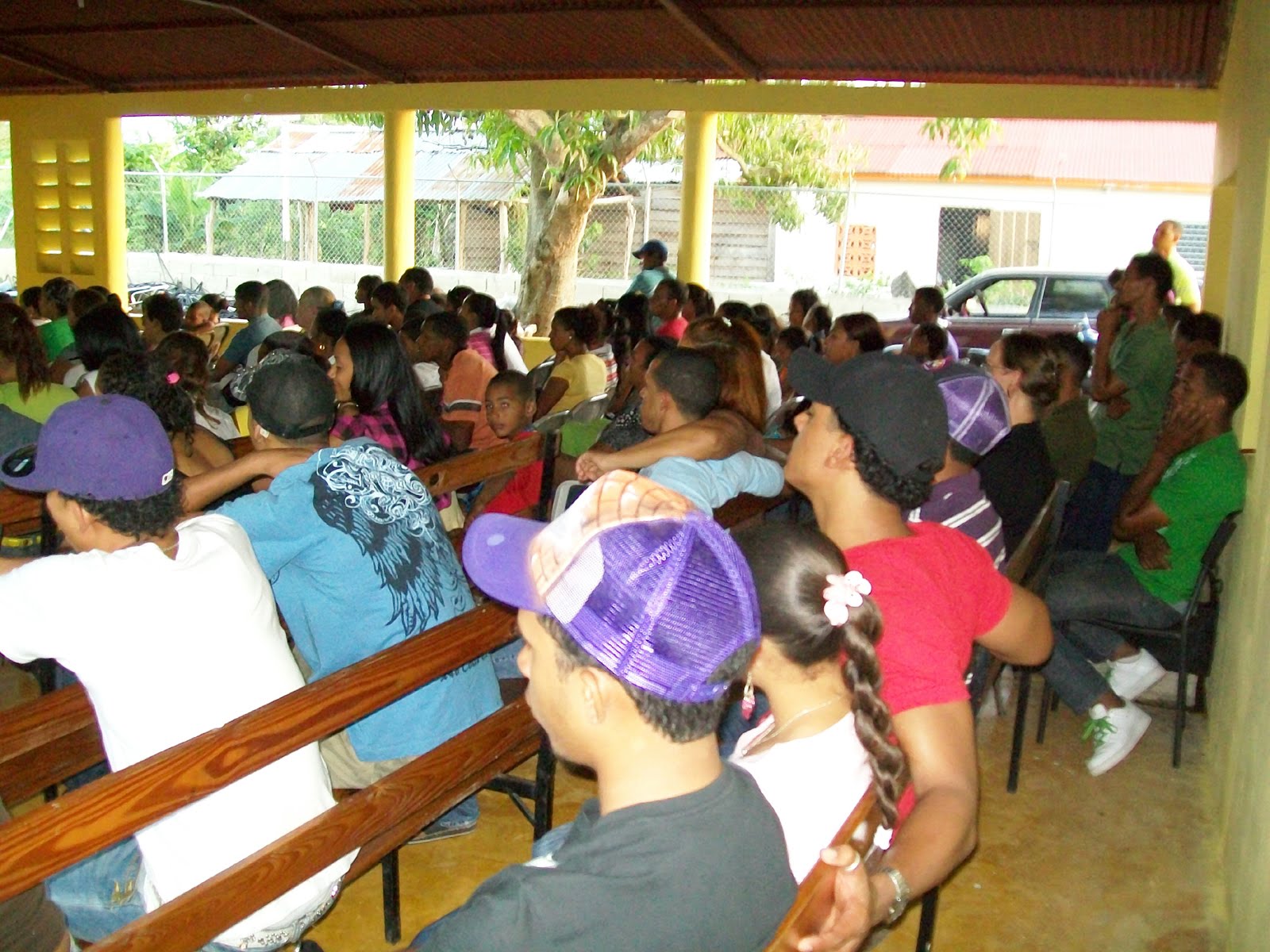
People started arriving and before long almost every spot was taken. Most of the members were in attendance but there were many, many new faces. The children sat up front and the majority of them sat through the entire film. A quick count came to 150 people present.

After the film, Pastor Alex gave a brief Law and Gospel presentation pointing out the real motive for Jesus' suffering and death. He also spoke of the hope and peace we have through knowing that He was suffering for MY sins, forgiving ME.
Everyone was invited to return on Sunday for part II of the story,
"The Road to Emmaus".
Subscribe to:
Posts (Atom)

 Posts
Posts